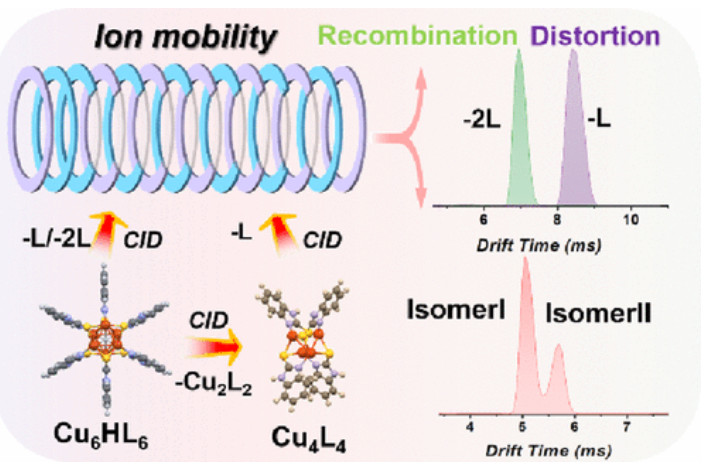
Ligand removal, as a key strategy for regulating the properties and catalytic activity of metal clusters, has been widely applied in numerous studies. However, direct evidence at the atomic scale regarding the specific effects of ligand removal on cluster structure and its evolution process remains lacking. To elucidate the structural changes in clusters during ligand removal, this study used the Cu₆HL₆ cluster and its major fragment ion, Cu₄L₄, as model systems. By combining ion mobility mass spectrometry (IM-MS) with ab initio molecular dynamics (AIMD) simulations, we systematically investigated their structural evolution during ligand removal.
The results indicate that during the gradual ligand removal process, the Cu₆HL₆ cluster first exhibits slight distortion of the metal core. AIMD simulations further revealed the dynamic process of structural reorganization induced by ligand removal. As ligands were progressively stripped away, the metal core underwent significant reorganization. Furthermore, after losing a ligand, the Cu₄L₄ cluster’s metal core also underwent a conformational change, forming two stable isomers. This isomerization behavior may stem from altered interligand interactions within the cluster.
This study challenges the conventional view that “ligand removal does not affect the overall structure of the cluster,” proposing that ligand stripping can induce structural reorganization or even isomerization of the cluster, thereby significantly affecting its stability and potential functionality. The experimental and simulation methods employed demonstrate good general applicability and are suitable for studying the structural evolution of other metal cluster systems, providing a new perspective for a deeper understanding of the dynamic regulation mechanisms of cluster structures. Furthermore, the structural evolution observed in the gas phase provides important insights into structural changes in metal clusters in the solution phase.
Original link: https://doi.org/10.1021/acs.jpca.5c01354

